
CA Naveen Pandey
CA + CS + CMA (AIR 5)
Founder : Naveen Pandey & Associates
has drafted and represented GST notice replies for Dwarka traders and shop owners since 2014.
GST Notice Reply Guide for Dwarka Traders — 2026

GST Notice Reply Guide for Dwarka Traders & Shop Owners — CA Naveen Pandey & Associates
At a Glance
A GST notice is not automatically a penalty. How you respond, and within what timeframe, determines whether it costs nothing, 10%, or up to 100% of the tax in penalty. For FY 2024-25 onward, every notice falls under one unified provision: Section 74A.
A GST notice is not automatically a penalty. What actually determines whether it costs you nothing, 10% of the tax involved, or up to 100% in penalty is how you respond, and within what timeframe. We’ve drafted and represented GST notice replies for traders and shop owners across Dwarka’s District Centre and Sector 6 and 10 markets since 2014, as part of our broader CA in Dwarka practice, and the single biggest factor in every case we’ve handled is speed, not the notice itself. This guide walks through exactly what kind of notice you might be holding, what section governs it, and what to do next.
What Kind of GST Notice Have You Actually Received?
Most guides jump straight into legal sections, which is confusing if you don’t yet know what you’re holding. Start by matching your notice to one of three tracks: a scrutiny notice, a formal demand notice, or a registration-cancellation notice, since each follows a different process with different deadlines.
ASMT-10 — The Scrutiny Notice Most Traders See First
ASMT-10 is usually the first contact a Dwarka trader gets, issued under Section 61 when the department’s systems flag a mismatch, commonly between GSTR-1 and GSTR-3B, ITC claimed in GSTR-3B exceeding what GSTR-2B shows as eligible, or turnover reported in GST returns not matching income-tax or e-way-bill data. It does not itself create a tax demand. You reply in Form ASMT-11 within 30 days of service, either explaining the discrepancy or accepting it and paying the differential tax with interest through Form DRC-03. If your explanation satisfies the officer, the matter closes with Form ASMT-12 and nothing further happens. If it doesn’t, the case can escalate to a formal show-cause notice.
DRC-01A and DRC-01 — The Formal Demand Track
DRC-01A is an informal pre-notice intimation, issued before the formal show-cause notice, giving you a chance to pay voluntarily at the lowest available penalty tier before the department commits to a formal notice at all. DRC-01 is the formal show-cause notice (SCN) itself, issued under Section 73, 74, or 74A depending on which financial year your notice covers. This is the notice that actually starts the clock on your reply deadline and penalty exposure, covered in detail in the next two sections.
REG-17 — A Different Track: Registration Cancellation
REG-17 is worth distinguishing clearly, since traders sometimes confuse it with a tax-demand notice and respond the wrong way. It’s a notice proposing cancellation of your GST registration itself, not a tax demand, issued under Rule 22 of the CGST Rules. You must reply in Form REG-18 within seven working days. If your reply satisfies the officer, proceedings are dropped via Form REG-20; if not, a cancellation order follows in Form REG-19. Registration issues sometimes surface during GST registration in Dwarka itself, particularly around bank account validation mismatches, so it’s worth checking your registration profile if you receive this notice unexpectedly.
Section 73, 74, or 74A? Why the Year of Your Notice Matters
The single most important, current fact for Dwarka traders holding a GST notice today: for FY 2024-25 onward, every GST demand notice, whether the department alleges fraud or not, is issued under one unified provision, Section 74A. Sections 73 and 74 remain the operative provisions only for periods up to FY 2023-24.
Section 74A was inserted by the Finance (No. 2) Act, 2024, following the 53rd GST Council meeting, and it changes something genuinely helpful for Dwarka’s small traders: whether your case is treated as fraud or non-fraud is now decided at adjudication, not declared upfront at the notice stage. Under the old Section 74 structure, a fraud allegation was baked into the notice from day one. Under 74A, that determination happens later, which reduces the risk of a premature fraud label attaching to what might just be a genuine reconciliation error.
|
Period |
Applicable Section |
Time Limit for SCN |
Fraud/Non-Fraud Determined |
|---|---|---|---|
|
Up to FY 2023-24 |
Section 73 (non-fraud) or Section 74 (fraud) |
3 years (Sec 73) / 5 years (Sec 74) |
At the notice stage, upfront |
|
FY 2024-25 onward |
Section 74A (unified) |
42 months from the annual return due date or erroneous refund date |
At adjudication, not upfront |
No show-cause notice is required at all where the tax involved for a financial year is below ₹1,000 — a genuinely useful threshold most competitor guides miss. Once a Section 74A notice is issued, the officer must pass the final order within 12 months, extendable by up to 6 months (18 months total); if no order is issued within that window, proceedings are deemed concluded in the taxpayer’s favour.
If you’re still building out your registration and compliance basics, our GST registration guide for small businesses in Dwarka covers the earlier end of this journey.
This shift in when fraud gets decided matters more in practice than it might sound. Under the old Section 74, a trader whose supplier turned out to be fraudulent, or who had a genuine reconciliation gap between GSTR-2B and GSTR-3B, could still be hit with a fraud-tier notice from day one, simply because the officer’s initial suspicion drove the section chosen. Under Section 74A, that same trader now gets adjudicated on the actual facts before the higher penalty tier is locked in, which means a well-documented reply arguing the absence of fraud, disclosure made in good faith, or cooperation during scrutiny can genuinely change the outcome, not just soften it after the fact. For Dwarka traders dealing with supplier-side ITC issues in particular, since fake or cancelled-registration suppliers are a common trigger for fraud allegations at the recipient’s end, this distinction is worth raising explicitly in your reply rather than assuming the classification is fixed.
The Penalty Ladder — What Paying Early Actually Saves You
Under Section 74A, which governs any notice for FY 2024-25 onward, the penalty you actually pay depends entirely on when you pay, not just whether you’re found at fault. For non-fraud cases, this is more forgiving than most guides describe: the zero-penalty window doesn’t end at the notice, it extends 60 days past it.
|
Payment stage |
Non-fraud classification |
Fraud classification |
|---|---|---|
|
Before the SCN is issued |
No penalty (tax + interest only) |
15% of tax due |
|
Within 60 days of the SCN |
No penalty (proceedings deemed concluded) |
25% of tax due |
|
Within 60 days of the final order |
10% of tax due or ₹10,000, whichever is higher |
50% of tax due |
|
After that |
10% of tax due or ₹10,000, whichever is higher |
100% of tax due |
The practical takeaway for a Dwarka trader is straightforward: if you genuinely owe the tax, paying within 60 days of the SCN in a non-fraud case closes the matter with no penalty at all, only tax and interest. That 60-day window is double the 30 days allowed under the old Section 74 structure, which gives you meaningfully more room to gather documents, reconcile figures, and decide whether to pay or contest, without the penalty clock working against you as fast as it used to.
How to Reply — From DRC-01 to DRC-06
Once you’ve received a formal DRC-01 show-cause notice, your response follows a fixed sequence, and the deadline for that sequence is non-negotiable: 30 days to file your formal reply.
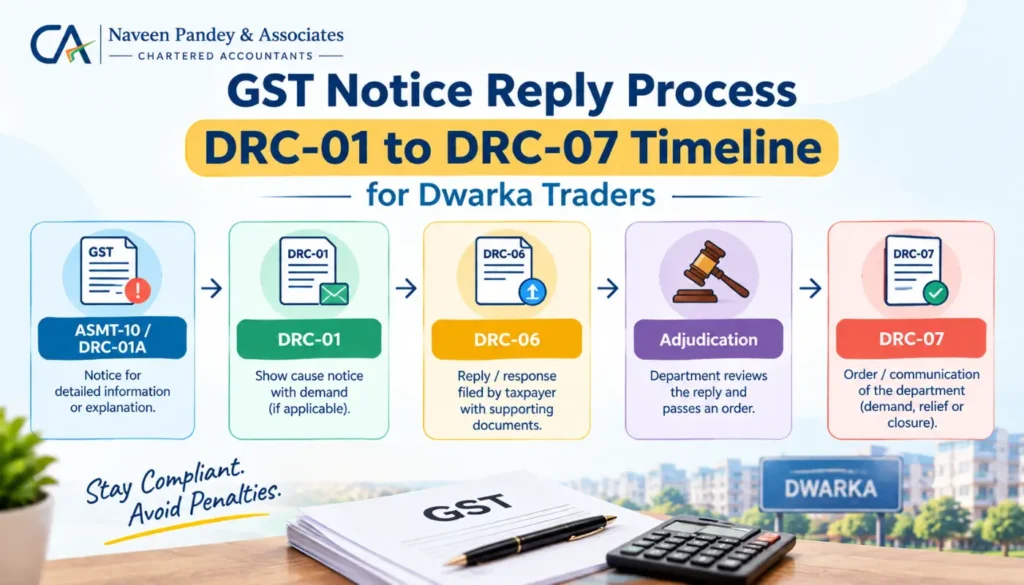
Start by verifying the section cited and the period covered. A notice citing Section 74 for a FY 2024-25 transaction, for instance, would be citing the wrong provision entirely, since that year falls under 74A, and this kind of error is worth flagging in your reply rather than silently accepting the notice as drafted. Next, verify the amount and the reasoning behind it, since notices are sometimes based on data mismatches that a straightforward reconciliation resolves without any real liability, particularly where the department’s automated matching between GSTR-1, GSTR-3B, and GSTR-2B hasn’t accounted for a genuine timing difference between when a supplier files and when you claim the corresponding credit. Gather your supporting documents: invoices, e-way bills, GSTR-2B versus GSTR-3B reconciliation statements, bank statements showing actual payment flows where relevant, and any correspondence from an earlier ASMT-10 stage if one preceded this notice.
With that in hand, file Form DRC-06 on the GST portal within 30 days of the DRC-01, addressing each point the notice raises individually rather than offering a general denial, since a reply that doesn’t engage with the specific discrepancies cited tends to get treated the same as no reply at all. If part of the demand is genuinely owed and part is contestable, it’s usually worth paying the undisputed portion while contesting the rest, since this can influence which penalty tier applies to the remaining amount. The GST portal’s notices and orders section is where you’ll find the DRC-01 itself and where DRC-06 gets filed.
What Happens If You Don’t Reply
If you don’t file Form DRC-06 within the 30-day window, the officer can pass an ex-parte order in Form DRC-07 based solely on the department’s version of events, without your side ever being considered. That order carries the full weight of a final demand, and recovery proceedings can follow directly from it.
The real cost isn’t just the penalty tier you land on by missing the deadline. It’s losing the chance to contest facts that might have reduced or eliminated the demand entirely, a mismatch that was actually a data-entry error on the department’s side, or an ITC claim that was fully valid but poorly documented in your original filing. Once a DRC-07 order is passed, your options narrow to an appeal under Section 107, which requires a pre-deposit of the disputed amount and moves considerably slower than a timely DRC-06 reply would have, often taking months to reach a hearing rather than the weeks a straightforward reply would have needed.
For a Dwarka shop owner, this timing difference has a direct working-capital impact. Recovery proceedings following an ex-parte DRC-07 order can extend to attaching bank accounts or property, which affects day-to-day trading in a way that a contested reply within the 30-day window would have avoided entirely, even where the underlying facts might ultimately have gone in the department’s favour.
What We See Most Often — GST Notice Mistakes Dwarka Traders Make
In 14+ years of handling these cases, a handful of patterns repeat often enough to be worth naming directly.
Ignoring a DRC-01A intimation, treating it as something that can wait, only to have it escalate to a formal DRC-01 with higher penalty exposure than the intimation stage would have carried. A DRC-01A is genuinely the cheapest point to resolve a genuine liability.
Assuming an ASMT-10 scrutiny notice is the same as a final demand. It isn’t. Many traders panic and either overpay to make it go away or ignore it entirely, when a properly reconciled ASMT-11 reply often closes the matter without any liability at all.
Missing the 30-day DRC-06 deadline simply because the notice sat unread on the GST portal dashboard. Notices don’t always arrive by SMS or email in a way that gets noticed immediately, and the 30-day clock doesn’t pause for that.
Not realising the fraud or non-fraud classification can be contested. Some traders assume a fraud citation under Section 74 or 74A is final and settle at the higher penalty tier without pushing back on the classification itself, when the facts of the case often support a genuine non-fraud argument.
Confusing a registration-cancellation notice under REG-17 with a tax-demand notice, and responding to the wrong process entirely, which wastes the short seven-working-day window REG-17 actually allows.
GST Notice Support for Dwarka Traders and Shop Owners
We support GST notice replies for Dwarka traders from our office in Vikaspuri, 4.7 km away, with document handling done primarily online via WhatsApp and email so time-sensitive deadlines don’t depend on an in-person visit. We’ve served District Centre and Sector 6 and 10 market businesses since 2014, and understand the notice patterns specific to retail and trading operations in this part of Dwarka.
If a notice has also prompted you to reconsider how your business is structured, our Company Registration in Dwarka page covers what’s involved in setting up a cleaner entity structure going forward.
Frequently asked questions
If you miss the 30-day reply window for a DRC-01 show-cause notice, the officer can pass an ex-parte order in Form DRC-07 based only on the department’s assessment. This carries full demand weight, and your only remaining option becomes a slower, costlier appeal process.
You have 30 days from the date of service to file Form DRC-06 in response to a DRC-01 show-cause notice. For a scrutiny notice in ASMT-10, the reply window is also 30 days, filed in Form ASMT-11, sometimes extendable at the officer’s discretion.
Section 74A is the unified provision governing all GST demand notices for FY 2024-25 onward, replacing the earlier fraud/non-fraud split between Sections 73 and 74. It sets a 42-month notice limit and decides fraud classification at adjudication rather than upfront at the notice stage.
Section 73 applies only to periods up to FY 2023-24, in non-fraud cases. No penalty applies if tax and interest are paid before or within 30 days of the notice. After that, the penalty is 10% of the tax due or ₹10,000, whichever is higher.
No. Before cancellation, the department must issue a show-cause notice in Form REG-17, giving you seven working days to reply in Form REG-18. If your reply is satisfactory, proceedings are dropped; if not, a cancellation order follows in Form REG-19.
CA Naveen Pandey
CA | CS | CMA with AIR 5 | B.Com, Delhi University | ICAI Registered
CA Naveen Pandey is the founder of Naveen Pandey & Associates, a Vikaspuri-based chartered accountancy firm serving 100+ Dwarka clients since 2014. He holds CA, CS, and CMA qualifications simultaneously — clearing CA Final in the first attempt in 2012. He specialises in ITR filing, NRI taxation, GST compliance, and transfer pricing. CA Naveen Pandey personally reviews every client file before it is assigned to the team.
Get Help With Your GST Notice
If you’ve received any kind of GST notice, whether it’s an ASMT-10 scrutiny notice, a formal DRC-01, or a REG-17 registration notice, contact us for a consultation, and bring the notice itself along with your relevant returns so we can assess your actual position rather than estimates.
Office (4.7 km from Dwarka)
DG-2/7B, First Floor, Vikaspuri, New Delhi – 110018
Phone / WhatsApp
14+ years of practice. Handling GST notices for Dwarka traders since 2014.
CA Services in Dwarka
All CA Services Under One Roof

Open All 7 Days Including Sunday
We Understand your busy schedule. Get expert CA help any day of the week.