
CA Naveen Pandey
CA + CS + CMA (AIR 5)
Founder : Naveen Pandey & Associates
helps businesses and employers with TDS returns, corrections and certificates.
Form 138, 140, 144, 143: New TDS Return Forms Explained
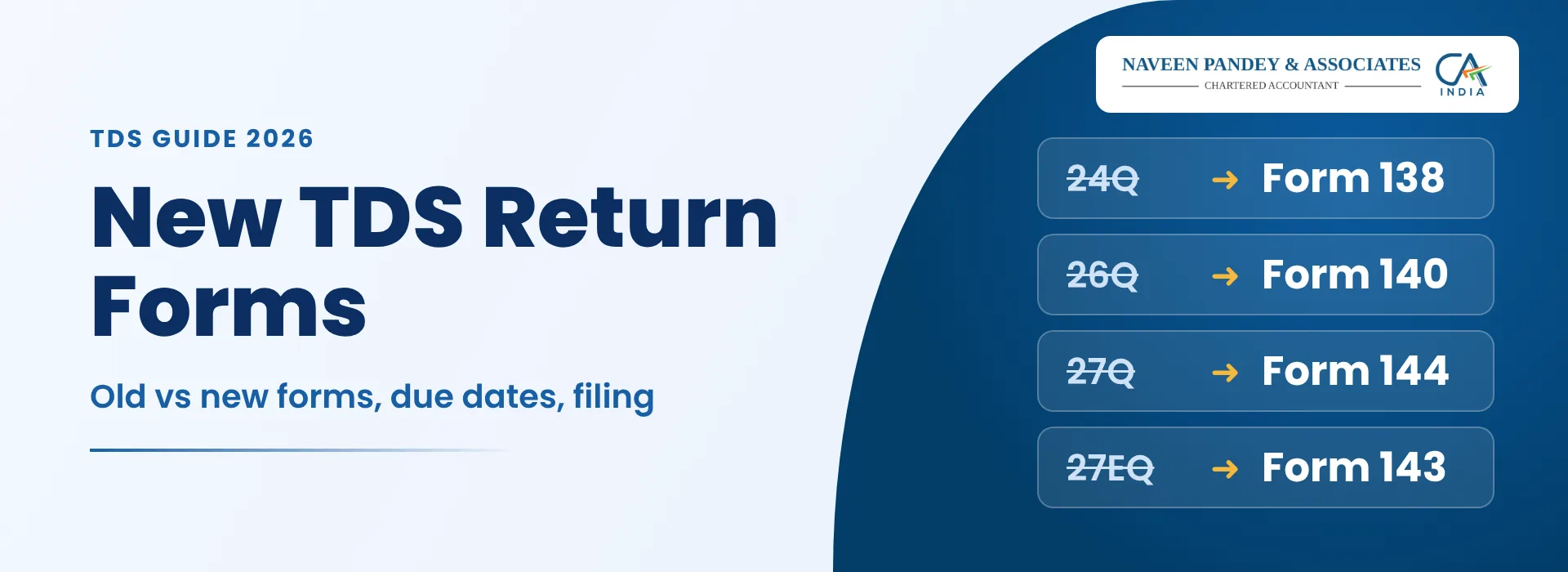
New TDS Return Forms 2026 — CA Naveen Pandey & Associates
Reviewed by CA Naveen Pandey on 27 November 2026
From 1 April 2026, Form 138 replaced Form 24Q and Form 140 replaced Form 26Q. Form 144 replaced Form 27Q, and Form 143 replaced Form 27EQ. These new TDS return forms are the quarterly Tax Deducted at Source (TDS) and Tax Collected at Source (TCS) statements. They come under the Income-tax Act, 2025 and the Income-tax Rules, 2026. The due dates stay the same: 31 July, 31 October, 31 January and 31 May.
Statements for FY 2025-26 and earlier still use the old forms. This guide gives the full old vs new table. It also shows which form fits which payment and how to file on the e-Filing portal.
Key points
- Salary TDS: Form 138 (formerly 24Q). Other payments to residents: Form 140 (formerly 26Q).
- Payments to non-residents: Form 144 (formerly 27Q). TCS: Form 143 (formerly 27EQ).
- Property purchase, and rent or fees paid by individuals and HUFs: Form 141, paid and filed within 30 days from the end of the month of deduction.
- TDS certificates: Form 130 (formerly Form 16) and Form 131 (formerly Form 16A).
- FY 2025-26 and earlier statements: old forms and the old utility.
What Are Form 138 and Form 140?
Form 138 and Form 140 are the two TDS statements most businesses file. Form 138 (formerly Form 24Q) reports TDS on salary under Section 392. Banks also use it for TDS on pension or interest paid to specified senior citizens. Form 140 (formerly Form 26Q) reports TDS on all other payments to residents, such as rent, professional fees, contract payments, commission and interest.
Both are quarterly statements under Section 397(3)(b) of the Income-tax Act, 2025, read with Rule 219 of the Income-tax Rules, 2026. An employer who pays salaries, and also pays rent or professional fees, files both forms every quarter. The form is new, but the job is the same as before. You report each deduction against the PAN of the deductee (the person whose tax you deduct), so that they get credit for the tax.
Form 140 has a deductee-wise annexure. For each payment, it shows the challan, the deductee's PAN and name, the section code, the date and amount paid, and the TDS deducted. It also records the reason for any lower or nil deduction, such as a Form 121 declaration or a lower TDS certificate.
Old vs New TDS and TCS Forms: Full Table
Here is every TDS and TCS form a business or individual is likely to use, with its old name.
| New form (from 1 April 2026) | Old form | What it is for | Due date |
|---|---|---|---|
| Form 138 | Form 24Q | Quarterly TDS statement on salary | 31 Jul, 31 Oct, 31 Jan, 31 May |
| Form 140 | Form 26Q | Quarterly TDS statement on other payments to residents | Same as Form 138 |
| Form 144 | Form 27Q | Quarterly TDS statement on payments to non-residents | Same as Form 138 |
| Form 143 | Form 27EQ | Quarterly TCS statement | Same as Form 138 |
| Form 141 | Forms 26QB, 26QC, 26QD, 26QE | Challan-cum-statement: property purchase by any buyer, and rent, contract or professional fees and crypto (virtual digital asset, VDA) payments by individuals and HUFs | 30 days from the end of the month of deduction |
| Form 130 | Form 16 | Salary TDS certificate | 15 June after the tax year |
| Form 131 | Form 16A | Non-salary TDS certificate | 15 days after the quarterly statement due date |
| Form 132 | Forms 16B, 16C, 16D, 16E | TDS certificate for Form 141 cases | 15 days after the Form 141 due date |
| Form 133 | Form 27D | TCS certificate | 15 days after the quarterly statement due date |
| Form 121 | Forms 15G and 15H | Self-declaration for no TDS on income | Given to the payer before payment |
| Form 128 | Form 13 | Application for a lower or nil TDS certificate | Apply before the payment |
There is one new form with no old match. Form 142 is a quarterly statement for crypto (VDA) exchanges. An exchange files it when it pays the tax on a transfer in place of the buyer.
Which TDS Form Should You File?
Pick the form by the person you pay and the type of payment. The payment types and their limits come from the TDS table in Section 393 of the Act.
| You pay | To | File |
|---|---|---|
| Salary | Employee | Form 138 |
| Rent, professional fees, contract payments, commission, interest, as a business or other deductor with a TAN | Resident | Form 140 |
| Any payment on which TDS applies | Non-resident, foreign company, or resident but not ordinarily resident (RNOR) | Form 144 |
| Price for property other than agricultural land (Rs 50 lakh or more) | Resident seller | Form 141 |
| Price for property | NRI seller, if you are a resident individual or HUF (from 1 October 2026) | Form 141 |
| Rent above Rs 50,000 a month, as an individual or HUF with no business, or whose turnover last year was up to Rs 1 crore (Rs 50 lakh for a profession) | Resident landlord | Form 141 |
| Contract payments, professional fees or commission above Rs 50 lakh in a year, as an individual or HUF who does not deduct TDS on these as a business | Resident | Form 141 |
| You collect TCS (Section 394) as a seller | Buyer | Form 143 |
You file Form 141 from your PAN login on the e-Filing portal. Under Section 397(1)(c), you do not need a TAN (Tax Deduction and Collection Account Number) for it. Companies and firms report TDS on rent, contract payments, professional fees and commission in Form 140 with their TAN. Individuals and HUFs above these turnover limits do the same.
Form 140 vs Form 144: a common mix-up
Form 140 is only for resident deductees. If you pay a non-resident consultant, landlord or seller, the TDS goes in Form 144, even for the same type of payment. From 1 October 2026, property bought by a resident individual or HUF is the one exception, explained below. In our practice, the most common TDS mistake is treating an NRI as a resident. A client pays rent to an NRI landlord or buys property from an NRI. They then use Form 140 or Form 141 Schedule B and deduct TDS at the lower resident rate. This leads to interest, a short-deduction default and corrections on TRACES.
Form 140 cannot be changed into Form 144, because they are separate statements. The fix has two steps: file a correction statement for Form 140, and report the deduction in Form 144.
When you send money to a non-resident, you may also need Form 145 and Form 146 (formerly Forms 15CA and 15CB). Our page on filing Forms 15CA and 15CB covers this step.
Buying property from an NRI
From 1 October 2026, a resident individual or HUF who buys property from an NRI uses Form 141 with PAN. A TAN is not needed for this. Other buyers still use a TAN and Form 144. Our guide on TDS on sale of property by NRI covers the rate, the Form 128 certificate and the buyer's steps.
Do the Old Forms Still Apply for FY 2025-26?
Yes. Statements for FY 2025-26 and earlier years stay on Forms 24Q, 26Q, 27Q and 27EQ. This includes a correction to an old quarter. The new Forms 138, 140, 144 and 143 apply from Tax Year 2026-27, which started on 1 April 2026.
Protean, the agency that provides the TDS return software, keeps two separate utilities. The new Return Preparation Utility (RPU) is for Tax Year 2026-27 onwards. The older RPU is for statements up to FY 2025-26. If you use the wrong one, the file will not match the form you select on the portal.
The same split applies to certificates. Salary paid in FY 2025-26 is covered by Form 16. Form 130 covers tax deducted from 1 April 2026, and the first one is due by 15 June 2027.
TDS Return Due Dates for Tax Year 2026-27
The quarterly due dates for Forms 138, 140, 144 and 143 are set in Rule 219(4).
| Quarter | Period | Due date |
|---|---|---|
| Q1 | April to June 2026 | 31 July 2026 |
| Q2 | July to September 2026 | 31 October 2026 |
| Q3 | October to December 2026 | 31 January 2027 |
| Q4 | January to March 2027 | 31 May 2027 |
The statement comes after the deposit. Non-government deductors deposit TDS by the 7th of the month after the month of deduction. TDS deducted in March is due by 30 April (Rule 218). Form 141 works differently. It is a challan and statement in one. You pay the tax and file it together, within 30 days from the end of the month in which you deducted the tax.
How to File Form 138 or Form 140 on the e-Filing Portal
You upload the statement on the Income Tax e-Filing portal, where you log in with your TAN. The steps below follow the official Form 138 and Form 140 user manuals.
- Prepare the file. Download the latest RPU from the Protean website. Enter the deductor, challan and deductee details.
- Validate it. Run the File Validation Utility (FVU) to create the .fvu file, then put it in a .zip file.
- Log in with TAN. Go to e-File > Income Tax Forms > File Income Tax Forms. Under "Forms as per Income Tax Act 2025", choose "Deduction and Collection at source (Form TDS/TCS)".
- Select and upload. Choose Form 138 or Form 140, the tax year, the quarter and Regular or Correction. Upload the .zip file.
- Verify and track. E-verify with your digital signature certificate (DSC) or another listed method. Check the status under e-File > Income Tax Forms > View Filed Forms. An accepted statement goes to TRACES for processing.
Before you start, your TAN must be registered on the e-Filing portal. If you file with a DSC, it must be registered on the portal too.
Why the portal rejects a TDS statement
The user manual lists these common reasons:
- Wrong tax year selected.
- The same quarter filed twice.
- The FVU version you used does not match the version shown on the portal.
- A correction file uploaded as a regular statement, or the other way round.
- The TAN in the file does not match the TAN you logged in with.
- In a correction, the RRR (the receipt number of the original statement) does not match.
If the portal rejects the form, fix the error and upload the corrected .zip file again.
Late Fee, Interest and Penalty Under the New Act
The section numbers changed, but the amounts did not.
- Late fee: Rs 200 for each day after the due date until you file, up to the TDS amount, under Section 427 (formerly 234E).
- Interest: 1% a month if you deduct late, and 1.5% a month if you deduct but deposit late, under Section 398 (formerly 201(1A)).
- Penalty: Rs 10,000 to Rs 1,00,000 for not filing or for wrong details, under Section 461 (formerly 271H). There is no penalty for a late statement if you pay the tax, fee and interest, and file within one month of the due date.
Our TDS interest calculator works out both the interest and the late fee for Forms 138, 140 and 144.
Form 130 and Form 131: New Names for Form 16 and Form 16A
Form 130 (formerly Form 16) is the salary TDS certificate. The employer downloads it from TRACES and gives it to the employee by 15 June after the tax year (Rule 215). An employee with two employers in a year gets a certificate from each one for the months worked there.
Form 131 (formerly Form 16A) is the TDS certificate for other payments. You issue it within 15 days of the due date of the quarterly statement. Form 132 does the same job for Form 141 cases, and Form 133 is the TCS certificate. A certificate is valid only when you generate it from TRACES.
Employees use Form 130 to check their salary and TDS before filing the return. Planning your salary under the new regime? See what still counts in our guide to deductions in the new tax regime.
Form 121 and Form 128: No TDS and Lower TDS
Form 121 replaced both Form 15G and Form 15H. It is one declaration for all ages, in place of separate forms for senior citizens and others. You give it to the bank or payer when your tax for the year will be nil. The payer then does not deduct TDS on your interest or similar income. Non-residents and companies cannot use it.
Form 128 (formerly Form 13) is the application for a certificate of lower or nil TDS or TCS. You file it with the Assessing Officer. It helps most when TDS at the normal rate would be far more than your actual tax.
How We Handle TDS Work
We handle TDS work for businesses, employers and individuals from our office in Vikaspuri, New Delhi. This covers monthly TDS deposits and quarterly statements in Forms 138, 140, 144 and 143. It also covers Form 141 for property and rent, correction statements, and certificates in Forms 130, 131, 132 and 133. Before a deduction, we check the deductee's PAN status and any Form 121 declaration. We also prepare Form 128 applications for lower TDS and Forms 145 and 146 for payments sent abroad. For businesses whose books we keep, TDS is part of our accounting and bookkeeping routine. That way, the monthly deposit and the quarterly statement come from the same books.
Frequently Asked Questions
What is Form 138 in TDS return?
Form 138 is the quarterly TDS statement for salary under the Income-tax Act, 2025. It replaced Form 24Q from 1 April 2026. Employers file it for TDS on salary. Specified banks also file it for TDS on pension or interest of specified senior citizens. The due dates are 31 July, 31 October, 31 January and 31 May.
What is the difference between Form 138 and Form 140?
Form 138 reports TDS on salary. Form 140 reports TDS on all other payments to residents, such as rent, professional fees, contract payments and interest. A business that pays both salaries and vendors files both forms each quarter. Payments to non-residents go in Form 144, not in Form 140.
What is the old name of Form 140?
Form 140 was earlier called Form 26Q. It applies to TDS deducted from Tax Year 2026-27 onwards. For FY 2025-26 and earlier years, including corrections, you still file Form 26Q with the older utility.
How do I file Form 140?
Prepare the file in the latest Protean RPU and validate it with the FVU. Log in to the e-Filing portal with your TAN and open e-File > Income Tax Forms > File Income Tax Forms. Choose Form 140, the tax year, the quarter and Regular or Correction, then upload the .zip file and e-verify.
Which form replaced Form 27Q?
Form 144 replaced Form 27Q. You file it every quarter for TDS on payments to non-residents, foreign companies and residents who are not ordinarily resident (RNOR). The due dates are the same as for Form 138 and Form 140.
Is Form 16 still issued?
Form 16 was the salary certificate up to FY 2025-26. For tax deducted from 1 April 2026, the certificate is Form 130. The employer issues it by 15 June after the tax year, so the first one is due by 15 June 2027.
What is the late fee for filing Form 138 or 140 late?
The late fee is Rs 200 for each day after the due date until you file. It comes under Section 427 of the Income-tax Act, 2025 (formerly 234E). The total fee cannot be more than the TDS amount. A penalty of Rs 10,000 to Rs 1,00,000 can also apply if you file more than one month after the due date or give wrong details.
Need Help With Your TDS Returns?
We file Forms 138, 140, 144 and 143, fix rejected or wrong statements and download TDS and TCS certificates (Forms 130 to 133). Share your TAN details and challans to get started. Naveen Pandey & Associates, DG-2/7B, First Floor, Vikaspuri, New Delhi 110018. Open all 7 days.
Book a ConsultationSources: Form 138 user manual, Income Tax e-Filing portal · Procedure for preparation of TDS return, Protean
CA Naveen Pandey
CA | CS | CMA | B.Com, Delhi University | ICAI Registered
CA Naveen Pandey is the founder of Naveen Pandey & Associates, a chartered accountancy firm in Vikaspuri, West Delhi. He holds the CA, CS and CMA qualifications and has 14+ years of practice. Together with his team, he handles TDS returns, ITR filing, NRI taxation, GST compliance and accounting for 500+ active clients. CA Naveen Pandey personally reviews every client file before it is assigned to the team.
Our CA Services
Services we handle for individuals, NRIs and businesses:

Open All 7 Days Including Sunday
We understand your busy schedule. Get CA help any day of the week, including Sunday.